

Advertisement

Outgoing Vice Chancellor Recalls Leading Catholic University of South Sudan through War, Crisis

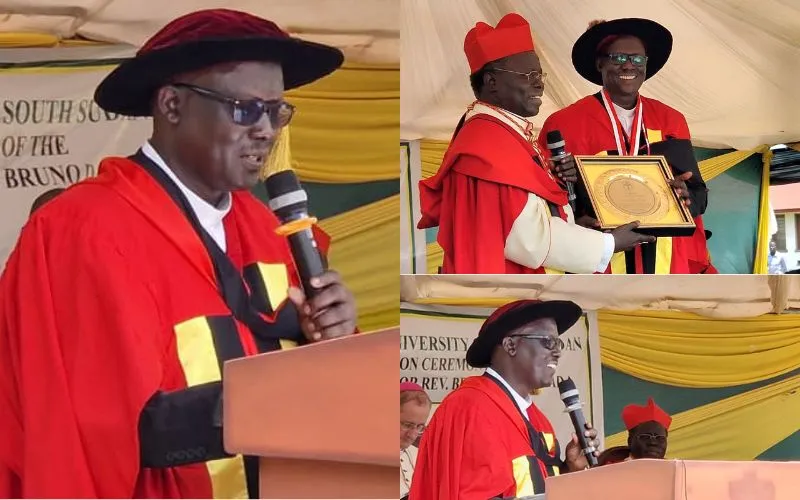
Fr. Mathew Pagan. Credit: Sr. Paola Moggi, CMS/Juba/South Sudan/Radio Bakhita

The outgoing Vice Chancellor (VC) of the Catholic University of South Sudan (CUofSS) has expressed gratitude to God, the Bishops, and all who supported him during him at the institution of higher learning for the last 12 years.

In his address during the September 1 installation of Br. Dr. Bruno Dada as the new VC of CUofSS, Fr. Mathew Pagan recalled challenges amid South Sudan’s “most turbulent times”, including sudden closures, financial strain, and prolonged struggles to pay salaries.

“I stand before you today … with a profound sense of gratitude to God with a heart full of joy that our good Lord has guided me and my colleagues in the leadership of the university through the most turbulent times in the history of our nation,” Fr. Pagan said.

He recounted his first days at the university, saying, “In my first week in the university, I was summoned by the students. They called me, they sat me (down), and they asked me what is going to happen to us. … I told them, this university will give you your future.”

The native of South Sudan's Malakal Catholic Diocese started his tenure as VC in November 2013, a month before the East African nation plunged into civil war after President Salva Kiir accused his then Vice President, Dr. Riek Machar Teny, of plotting a coup.
Advertisement

The political infighting brought to the light two factions of government forces, one loyal to Kiir and the other to Machar, in the violence that took place the streets of South Sudan’s capital city, Juba, where the CUofSS is headquartered.  

The violence quickly spread across the world’s newest nation, resulting in the displacement of hundreds of thousands of civilians by the start 2014. The fighting continued as a brutal civil war that affected the entire country.


In his September 1 address, Fr. Pagan recalled, “One month after, the war broke out. Then I said Lord is that the reason you brought me from Malakal to Juba to have a war like this? And now the university is closing, there is no money, where are we going to get the money ... to pay the staff?”

“When we came in, the university was not accredited; it was not registered with the Ministry of Higher Education. The programs were not approved. It took us three years until 2017 to achieve the accreditation,” Fr. Pagan further recalled.

More in Africa

He also recalled the early days of the CUofSS in bamboo structures and the mockery, “Father, you are the Vice Chancellor of that ‘rakuba’ near the river there? Are your students underwater?”

“When the Church starts a school, a university, the Church does not come and say we’re closed because it is bankrupt. The Church begins under a tree and it will grow … The time of the Church is determined by God; it’s not determined by us,” Fr. Pagan said, recognizing his resilience over the years.

He recalled, “There was nothing here … That was in 2013. Look at the grace of God today in 2025. So, God is good. And if you believe that God is good, imagine another 10 years to come, 15 years to come, and 20 years to come … great things will continue to happen because of the power that God has given us.”

Beyond infrastructure, he pointed to steady academic growth. The university began with just three programs in Juba and Wau. Today, it has expanded to more than 14, including Peace and Conflict Studies, Environmental Sciences, Communication and Media, Law, and Primary Education. New campuses in Yambio, Rumbek, and Malakal have also been established.

The canon lawyer, who earned his doctorate from the Pontifical Urbaniana University in Rome and later a Master’s degree in Peace and Development at the University of Juba, credited the university’s resilience to the dedication of staff, students, and Church leaders.

Advertisement

Fr. Pagan paid tribute to his successor, Br. Dada, whom he lauded for his “patience, humility, and for being an integral part of the process of the history of the Catholic University of South Sudan since 2008.”

Charles Muchiri contributed to the writing of this story

ACI Africa was founded in 2019. We provide free, up-to-the-minute news affecting the Catholic Church in Africa, giving particular emphasis to the words of the Holy Father and happenings of the Holy See, to any person with access to the internet. ACI Africa is proud to offer free access to its news items to Catholic dioceses, parishes, and websites, in order to increase awareness of the activities of the universal Church and to foster a sense of Catholic thought and culture in the life of every Catholic.