

Advertisement

Ghana’s Catholic Bishops Decry Illegal Mining as “public health, human rights emergency”, Urge Presidential Action

Credit: GCBC/Catholic Trends

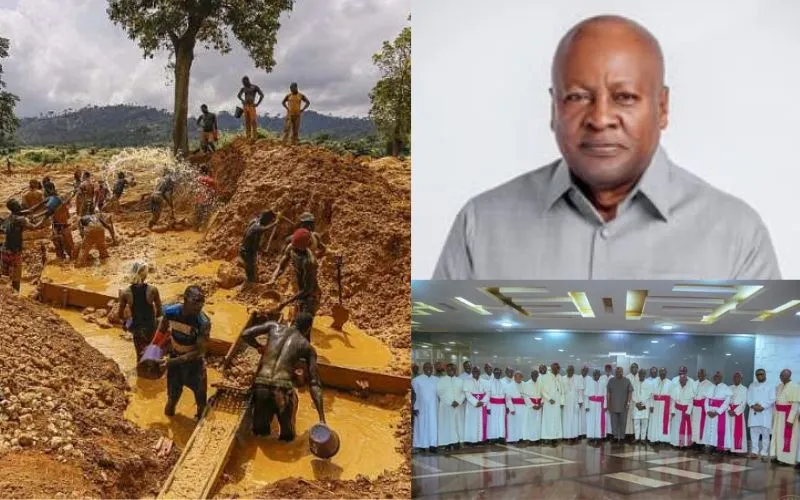
Ghana’s Catholic Bishops have urged President John Dramani Mahama to take action against illegal mining, popularly known as galamsey, which they say is “poisoning” the West African nation’s “life-support systems.”

In a statement addressed to the President during a High-Level Engagement on Galamsey on Friday, October 3, members of the Ghana Catholic Bishops’ Conference (GCBC) express “profound concern for the health, safety, and dignity of our people, and for the integrity of our common home.” 

They cite the Mercury and Heavy Metals Impact Assessment conducted by Pure Earth and the Ghana Environmental Protection Agency (EPA), along with testimony from the UN Special Rapporteur on Toxic Substances, as presenting “an alarming and irrefutable picture.”

“This is not merely an environmental issue; it is a public health and human rights emergency,” Ghana’s Catholic Bishops emphasize.  

They add, “The evidence is stark: mercury and arsenic levels in some communities exceed safe limits by hundreds of times. Rivers, soils, and crops are contaminated; over half a million farmers have been displaced; and children are already bearing the scars of toxic exposure. Our water, our food security, and the very future of our nation are at stake.”
Advertisement

Addressing President Mahama, GCBC members say, “The duty to protect the people and environment of Ghana rests primarily with the government. Yet the Catholic Church in Ghana, through her dioceses, parishes, schools, hospitals, and social interventions, stands ready to augment the state’s efforts in awareness, community mobilisation, and the building of a culture of stewardship.”

“We ask respectfully that you indicate to us, and to the nation, how best we may fit into this urgent national mission,” GCBC members further say.

They urge concrete action, including “clear benchmarks that will trigger a state of emergency; visible prosecution of kingpins, including those named in official reports; the establishment of promised fast-track courts; measurable performance indicators for local authorities and security services; and protection for communities and traditional leaders who resist galamsey, alongside accountability for those complicit.”

“Credibility is now as important as policy. Our people must see that no one is above the law, and that economic expediency cannot outweigh the sacred right to clean water, safe food, and a healthy environment,” the Catholic Church leaders say.

They urge the President to “act with courage and moral clarity. History will not measure your leadership by words alone, but by the protection you secure for generations yet unborn.”

More in Africa

“To delay is to risk complicity in what is fast becoming an ecocidal tragedy of monumental proportions,” they say in their statement that their President, Bishop Matthew Kwasi Gyamfi of Ghana’s Sunyani Catholic Diocese, signed.

On September 15, GCBC members reiterated their concern about the spread of illegal mining in the country and urged the government to declare a state of emergency in “mining zones” as a step toward addressing the perennial challenge that has attracted condemnation from other Church institutions.

In a statement, they describe the illegal and unregulated mining, commonly known as Galamsey, as “cancer,” which has currently become one of the gravest afflictions in the West African nation.

Jude Atemanke is a Cameroonian journalist with a passion for Catholic Church communication. He holds a Bachelor’s Degree in Journalism and Mass Communication from the University of Buea in Cameroon. Currently, Jude serves as a journalist for ACI Africa.