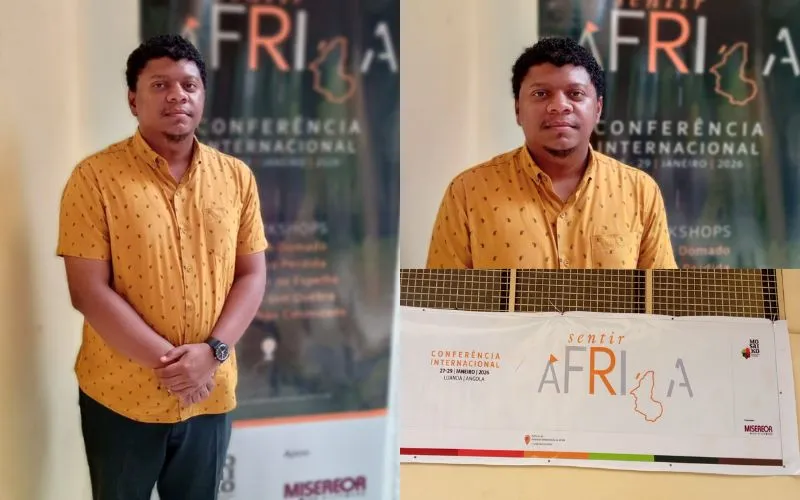
The 66-year-old Catholic Church leader went on to underscore the importance of witness, insisting that Christian identity must be visible not only through symbols such as habits or rosaries, but also through authentic living.
“Our witness is strongest when it is real and lived. Wearing a religious habit, a rosary, or a medal means nothing if our hearts are not converted. These are outward signs of an inner truth. If what we wear does not reflect who we are, then we misrepresent the Church,” he said.
He added, “Just as a corrupt policeman dishonors his uniform, a Christian who does not live the Gospel dishonors Christ.
Archbishop Phiri acknowledged that the call to holiness and evangelization is not without challenges, especially for those serving in the Church.
“It is not easy because sometimes those of us who serve the Church are scrutinized, even judged unfairly,” said Archbishop Phiri.
(Story continues below)
He urged the people of God to focus on helping each other to grow in holiness, saying, "Do not be quick to condemn; be quick to correct with love. Help your Priests, your friars, and your brothers and sisters in Christ to live faithfully."
“May God bless this occasion and all who, despite their weaknesses, continue striving for holiness. May God bless all the Conventual Friars and the rest of us who share in this mission,” he implored during the October 4 event on the feast of St. Francis of Assisi.
The Chairman of the Justice and Peace Commission of the Southern African Catholic Bishops’ Conference (SACBC) has condemned the corruption scandal at the country’s Tembisa Hospital, describing it as a grave injustice and a direct assault on the rights of the poor.
In a statement welcoming the investigative report released by the Special Investigating Unit (SIU), which exposed the looting of more than R2 billion (approximately USD 109 million) from the hospital, Bishop Thulani Victor Mbuyisa describes the scandal as a grave betrayal of public trust.
“This scandal constitutes not only a grave betrayal of public trust but also a direct attack on the dignity and rights of the poor who depend on public health care,” Bishop Mbuyisa says in the statement dated Friday, October 3.
The scandal dates back to 2021, when whistleblower Babita Deokaran, the Chief Director of Financial Accounting at the Gauteng Department of Health, was assassinated outside her home in southern Johannesburg after exposing irregular and suspicious payments at the hospital.
Some of the major irregularities that Ms. Deokaran reported include more than R850 million (approximately USD 46.3 million) in irregular contracts at Tembisa Hospital with 217+ service providers, many contracts valued under R500,000 (approximately USD 27,200) which bypassed stricter procurement rules.
She reportedly identified more than 200 potentially fraudulent companies doing business with the hospital, some of them letterbox entities that existed only on paper, which received large sums through contracts awarded over short periods.
Since then, SIU and other state organs have reportedly been investigating both the procurement irregularities she exposed and the murder. Proclamations have also been reportedly signed to empower deeper investigations.
In the October 3 statement, Bishop Mbuyisa says, “We recall the sacrifice of Babita Deokaran, who courageously exposed these irregularities and paid with her life for her fidelity to truth and justice.”
The Local Ordinary of South Africa’s Catholic Diocese of Kokstad says Ms. Deokaran’s assassination stands as “a sobering reminder of the grave risks faced by whistleblowers” in the Southern African nation.
“Justice for Babita Deokaran requires not only publication of reports but also concrete accountability through decisive prosecutions of those implicated,” The South African member of the Congregation of the Missionaries of Mariannhill (CMM) says.
He says that “While the SIU report is a necessary first step, justice will remain incomplete unless the South African Police Service (SAPS) and the National Prosecuting Authority (NPA) act on the SIU report with urgency, professionalism, and integrity.”
Bishop Mbuyisa denounces what he describes as “Persistent failures, characterized by delays, weak investigations, and botched prosecutions,” which he says have eroded public confidence in the institutions tasked with justice in the country.
“We therefore call on the Public Protector to intervene and ensure that prosecutions arising from the SIU report are conducted swiftly, decisively, and without compromise,” the South African Bishop says in his signed statement.
The SACBC Justice and Peace Commission chairperson explains that “the corruption of this magnitude is seldom confined to a single institution. We therefore urge the SIU to expand its investigations beyond Tembisa Hospital.”
“The looting of health budgets represents not only a criminal offence but a moral failure of the highest order,” he notes in the one-page statement.
He adds in reference to the book of Amos, “We therefore declare the words of God’s righteousness into the lives of those looting hospital budgets at the expense of the poor, lavishing themselves with stolen wealth while patients in public hospitals are left without medicine, equipment, and care.”
“You lie on beds of ivory and lounge on your couches. You dine on choice lambs and fattened calves. You drink wine by the bowlful and anoint yourselves with the finest oils, but you do not grieve over the ruin of Joseph,” Bishop Mbuyisa says further in reference to the book of Amos.
He adds, “We will continue to stand alongside the whistleblowers, praying and acting so that God’s justice may prevail.”
Nicholas Waigwa is a Kenyan multimedia journalist and broadcast technician with a professional background in creating engaging news stories and broadcasting content across multiple media platforms. He is passionate about the media apostolate and Catholic Church communication.