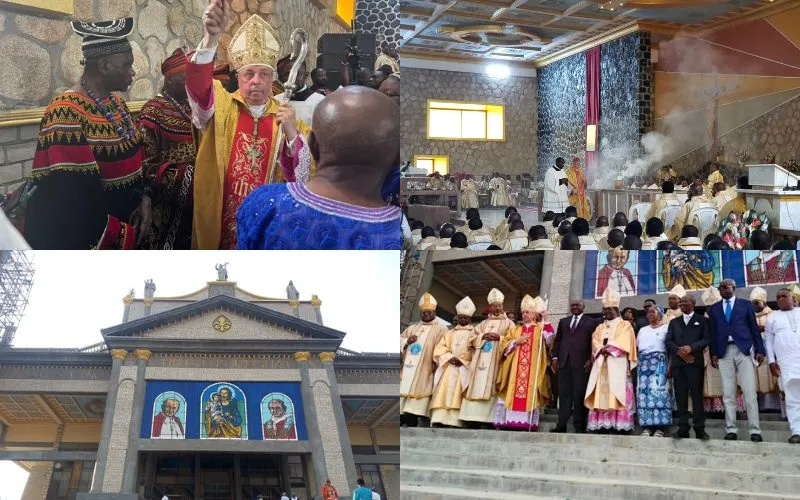
He implored, “May the expiatory spirit of the faithful of Bamenda, our dedication of this temple, be a time of reconciliation and peace for all.”
In his speech during the event, the Local Ordinary of Bamenda described the solemn rededication of St. Joseph Cathedral as a profound celebration of unity, hope, and shared faith among the people of God in the Archdiocese.
Archbishop Andrew Nkea Fuanya said the Cathedral stands as “a symbol of our unity,” built by the people of Bamenda themselves without external funding.
“Every Christian in this Archdiocese is represented in one of the stones used to build this Cathedral,” Archbishop Nkea said.
For him, the Cathedral is a symbol of hope for a people who have endured years of conflict due to the Anglophone crisis.
(Story continues below)
“In war, the people of Bamenda decided to put up this magnificent structure as a sign of their hope. Our hope can never deceive us,” the Local ordinary of Bamenda, who doubles as President of the National Episcopal Conference of Cameroon (NECC) said.
The renovated St. Joseph Cathedral sits on a surface area of 3,200 square metres, with dimensions measuring 48 metres in width and 68 metres in length.
A new roof was installed above the original structure, constructed in 1975, supported by 26 massive beams, each weighing 40 tonnes.
The Cathedral is accessed through a main tower that rises 16 metres and is flanked by valley structures, clearly identifying it as St. Joseph’s Cathedral. Inside, the worship space accommodates about 4,000 faithful.
Approximately 80 percent of the construction materials were sourced locally, including granite that stretches from the nave to the aisles.
A special cladding was also applied to the parapet wall to enhance durability and aesthetics. Renovation began in February 2024 and required an average of 74 workers each day to meet the November 2025 completion deadline.
Reflecting on the renovations, Archbishop Nkea highlighted the redesigned main door—dedicated to Mary and St. Joseph, with bronze panels depicting their histories—as well as the symbols of all Holy Years from 1900 to 2025 engraved on the interior.
On the rooftop, statues of Jesus the Redeemer, St. Joseph, the Blessed Virgin Mary, and all Twelve Apostles encircle the Cathedral, offering what Archbishop Nkea called a permanent blessing over Bamenda.
“Our Church is built on the foundation of the Twelve Apostles, and Jesus Christ is the cornerstone,” he said.
Within the Cathedral complex, Archbishop Nkea noted the restored burial chapel for Bishops—including the tomb of his predecessors – and the graves of Priests and Religious outside.
Renovating these, he said, was essential. “We could not renovate the church without renovating the graves” as a sign of the Church’s communion with the pilgrim, suffering, and triumphant Church, he said.
Archbishop Nkea appealed for prayers for peace in Cameroon and the growth of the Church, and implored, “May God bless all of you.”
Jude Atemanke is a Cameroonian journalist with a passion for Catholic Church communication. He holds a Bachelor’s Degree in Journalism and Mass Communication from the University of Buea in Cameroon. Currently, Jude serves as a journalist for ACI Africa.