


Advertisement

Madagascar’s Catholic Bishops Call for “authentic transformation,” Warn Against Return to Old Political Practices

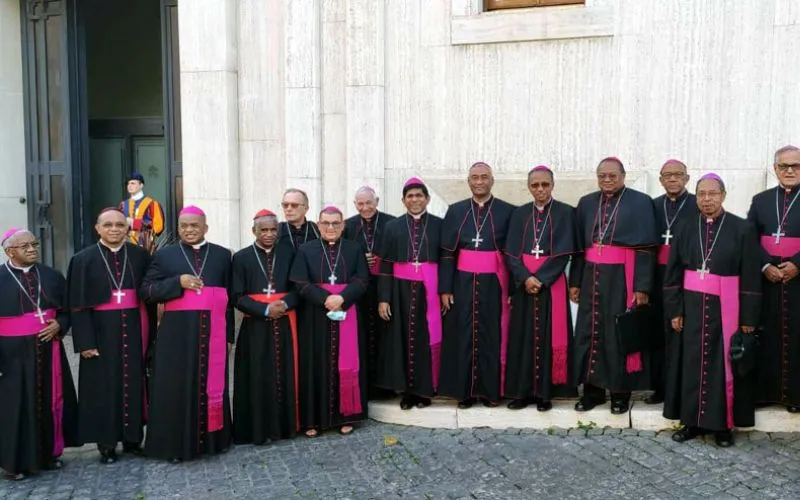
Members of the Episcopal Conference of Madagascar (CEM). Credit: Vatican Media

Members of the Episcopal Conference of Madagascar (CEM) have called for a “true and authentic transformation” of the nation, urging political leaders to break decisively with past governance failures and to commit to reforms that prioritize the common good.

In a statement issued following their November 4-14 Plenary Assembly in the Catholic Archdiocese of Antananarivo, CEM members recall that the country’s recent protests reveal the population’s “deep aspiration for real change” and a governance model centered on the common good rather than personal interests.

‘The Malagasy population could no longer bear the suffering caused by the lack of water, the frequent power cuts — basic needs, indeed — which led to street demonstrations. Added to this were endless corruption, abuses of power, and incompetence in public administration by leaders whom the people had trusted to serve and protect them,” the Catholic Bishops say in the message issued November 15.

They add, “Young people played a major role in these movements. The repression exerted by the security forces was not enough to stop their struggle.”

“These events clearly show that the Malagasy people, wounded and exhausted, aspire to a true and authentic transformation in the country and in governance,” the Catholic Church leaders say.
Advertisement

According to the CEM members, what the Malagasy people expect is social and public policy oriented toward the common good and sustainable development, not “a distorted politics where leaders seek only personal interests or those of their allies.”

They however warn of growing fears that the political process is already drifting away from people’s expectations.

“Many fear the return of old practices and the same actors who plunged the nation into crisis,” they caution, citing concerns about infiltrators paid to sabotage reform efforts.

On October 17, Col. Michael Randrianirina was sworn in as Madagascar’s new Head of State, in a ceremony that the High Constitutional Court officiated.

Col. Randrianirina was quoted as saying that his swearing in marked “a historic turning point” for the country, adding, “With a people in full fervor, driven by the desire for change and a deep love for their homeland, we joyfully open a new chapter in the life of our nation.”

More in Africa

The military leader expressed gratitude to the youth for spearheading demonstrations that led to the ouster of President Andry Rajoelina.

The October 17 inauguration at the Constitutional Court in the capital city, Antananarivo, followed the military takeover on October 14, the same day lawmakers impeached President Rajoelina, who had fled the country amid the unrest two days earlier, on October 12.

In their November 15 statement, the CEM members insist that leaders must prioritize reforms demanded by citizens, eradicate destructive practices that led to extreme poverty, and place the suffering of the people above the interests of a select few.

The Catholic Bishops call for a radical transformation of political culture in Madagascar, stressing that politics should be “a service for the people,” not a tool for personal gain.

“The Malagasy people must no longer be like owners begging for their rightful share, but must finally benefit from true, just, and lasting development,” the Bishops say.

Advertisement

They further urge leaders to eliminate excessive privileges and manage national resources fairly, dismantling networks that treat Madagascar “as their private property.”

“An inclusive national dialogue, starting from the grassroots, is necessary to move in this direction and to prepare a stable and solid State,’ the Catholic Bishops say.

They add, “Let the kind of politics that destroys the nation come to an end! Put an end to the politics of plunder and the pursuit of power for its own sake, as well as to the greed for national wealth. Do not manipulate the youth’s desire for renewal nor the people’s will to rebuild their history.”

The Bishops note that the “urgent priorities” of the people must come first, distinguishing between what is short-term and what is long-term. 

They further appeal that the two years foreseen for the transition be respected, adding that a major weakness in Madagascar’s development has been the lack of mutual listening and reciprocal trust. 

(Story continues below)

“We reaffirm that violence and vengeance, in any form whatsoever, can never lead to development nor bring peace and stability. The path to follow is that of reconciliation, communion, truth, and mercy. Bringing justice for committed crimes, theft, or forms of corruption must never be confused with political revenge,” the Catholic Church leaders say.

They further express admiration for the courage and patriotism of young Malagasies, saying their mobilization has given the country “a new vision.”

They encourage youth to remain united, avoid corruption, welcome guidance, and become builders of a renewed nation.

The CEM members insist that hope is not in vain, even amid the country’s challenges.

The ongoing Catholic Church’s 2025 Jubilee Year, they say, strengthens confidence in Christ and inspires perseverance.

Jude Atemanke is a Cameroonian journalist with a passion for Catholic Church communication. He holds a Bachelor’s Degree in Journalism and Mass Communication from the University of Buea in Cameroon. Currently, Jude serves as a journalist for ACI Africa.