Advertisement

“I am deeply sorry”: Bishop Kukah Says amid Criticism of Remarks on Genocide Targeting Christians in Nigeria

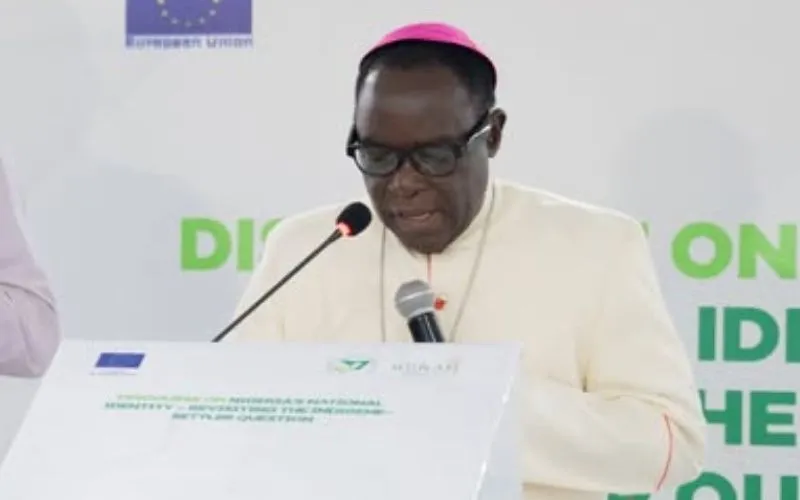
Bishop Matthew Hassan Kukah of the Catholic Diocese of Sokoto in Nigeria. Credit: Sokoto Diocese

Bishop Matthew Hassan Kukah of the Catholic Diocese of Sokoto in Nigeria has expressed regret that his position on the anguish of Christians in the West African nation has been misinterpreted.

In a statement published on Tuesday, December 9 by the Diocese of Sokoto, Bishop Kukah says he is “sincerely sorry” to be associated with “representations” stemming from “the pain of my brothers and sisters within the body of Christ.”

In the statement, the Nigerian Catholic Bishop dismisses allegations of him denying that there is persecution of Christians in Nigeria.

“For over a week, I have been in the news on the basis of multiple claims that I had said that there was no persecution of Christians in Nigeria,” Bishop Kukah says.

He adds, “First, let me say how sincerely sorry I am to be associated with representations that understandably are a source of great pain and mental anguish to so many of my brothers and sisters within the body of Christ.”

Advertisement

“I am baffled that despite the clarity of my position, there appear to be determined efforts to ascribe to me a position as saying that there is no persecution of Christians in Nigeria. Nothing could be further from the truth,” the Bishop of Sokoto since his Episcopal Consecration in September 2011 says.

He urges Nigerians to be focused on the “contest we must win”, amid heightened attacks targeting Christians and their institutions in Nigeria.

“I am deeply sorry for the unnecessary distraction,” he reiterates, and adds, “These moments are too serious for us to equivocate. This is not the time for us to retreat or be distracted. This is a contest that we must win.”

Bishop Kukah first encountered heavy criticism when he said, during the launch of the Aid to the Church in Need’s 2025 World Report on Religious Freedom in the World, that he did not believe that it was just Christians who are being persecuted across Nigeria, Africa’s most populous nation.

In his October 21 speech at the Augustinian Patristic Pontifical Institute in Rome, Bishop Kukah however acknowledged the deterioration of security in the country.

More in Africa

He said that “floods of blood in Nigeria” today “have no boundaries,” and added that “terrorist and murderous groups” who first emerged, targeting Church structures, kidnapping Priests, the Religious, Seminarians and other pastoral agents, while “invoking the words like, allahu akubar”, are now also killing Muslims who do not believe in their brand of Islam.

Bishop Kukah insisted, “We are not dealing with people going around wielding machetes and looking for me in order to kill me because I am a Christian.” 

His speech attracted a lot of criticism, with some believing that what the Local Ordinary of Nigeria’s Catholic Diocese of Sokoto said in Rome about persecution in his country did not address the anguish of Christians in the West African nation. 

Fr. Stan Chu Ilo, the Coordinating Servant of the Pan-African Catholic Theology and Pastoral Network (PACTPAN) felt that in the speech, Bishop Kukah missed “the deep anguish of believers living under the shadow of violence and fear” in Nigeria.

In what he described as “a divided pulpit in a wounded nation”, Fr. Stan juxtaposed Bishop Kukah's perspective and that of Bishop Wilfred Chikpa Anagbe of the Catholic Diocese of Makurdi who has been vocal about what he describes a genocide targeting Christians in Nigeria.

Advertisement

Bishop Anagbe has spoken extensively on persecution of Christians in Nigeria amid closure of Catholic Parishes across his Episcopal See and multiple displacements owing to heightened activities of Islamist Fulani herdsmen.

In a subsequent address to the 46th Supreme Convention of the Knights of St. Mulumba (KSM) in Kaduna on November 28, Bishop Kukah reportedly reaffirmed his stance that current claims of a genocide or systematic persecution of Christians in Nigeria are not supported by credible data.

Bishop Kukah argued that the claim “1,200 churches are burned every year in Nigeria”, lacks verification.

He asked, “In which Nigeria?”, pointing out that no one had checked with the Catholic Church to confirm such numbers.

The Bishop emphasized that “genocide” is defined not by the number of deaths or attacks alone, but by intent, whether there is a deliberate plan to eliminate a group. He said, “You can kill 10 million people, and it still won’t amount to genocide. What matters is intent.”

(Story continues below)

He also challenged the use of terms such as “martyrdom”, pointing out that some violence might be criminal or opportunistic rather than motivated by religious hatred.

In his statement published on December 9, the Bishop of Sokoto gave his position on the situation of Christianity in Nigeria, saying, “For the records, I did not say that Christians are not persecuted in Nigeria!”

He said that in his November 28 address, he spoke about the challenges of “bearing witness to Christ in a time of persecution.”

“I drew lessons from history and the stories of brave men and women in Nigeria and Africa as models of witnessing in times such as these.  I concluded that the greatest challenge for Christians was unity and solidarity,” Bishop Kukah said.

He added, “Given the huge human and material resources that we have as Christians in Nigeria, if only we stood together, I argued, we would have no reason to be victims of persecution. Nothing here implied a denial of the fate of Christians.”

The Bishop maintained that over the years, he had spoken extensively on the theme of persecution of Christians, and had argued “then as now” that “by whatever name we choose to call or describe our predicament, the bloodshed needs to end as soon as yesterday because our common humanity is at stake.”

Calling for urgent action to stop security in Nigeria, he said, “The government and its security agencies have an urgent responsibility to bring the perpetrators to account. It is their neglect of this duty or their failure to accomplish it that detains us all in an appearance of disagreement without difference.”

Agnes Aineah is a Kenyan journalist with a background in digital and newspaper reporting. She holds a Master of Arts in Digital Journalism from the Aga Khan University, Graduate School of Media and Communications and a Bachelor's Degree in Linguistics, Media and Communications from Kenya's Moi University. Agnes currently serves as a journalist for ACI Africa.