

Advertisement

Newly Appointed Archbishop of South Africa’s Cape Town Archdiocese Hopes to Build on Experience in Former Diocese

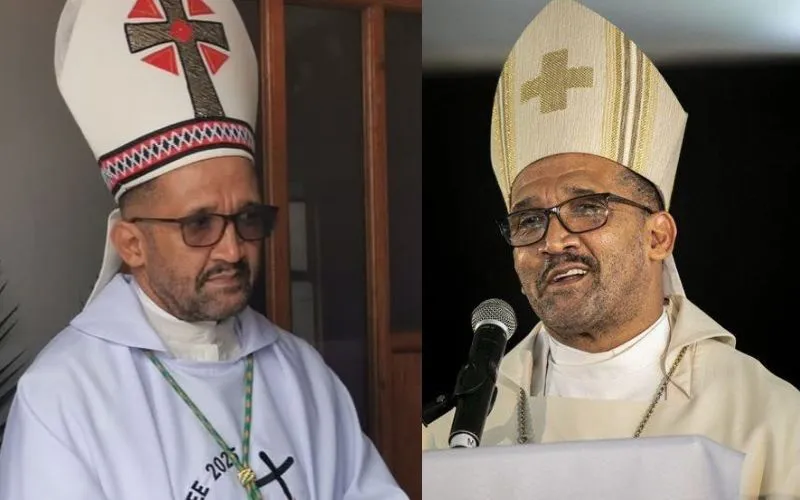
Archbishop-elect Bishop Sithembele Anton Sipuka. Credit SACBC/Facebook page.

Bishop Sithembele Anton Sipuka, who has been appointed as the Local Ordinary of the Metropolitan Archdiocese of Cape Town in South Africa, says he hopes to draw on his experience in the Diocese of Mthatha as he assumes leadership of the Archdiocese.

Speaking in an interview on Newzroom Afrika, Bishop Sipuka noted that although the Diocese of Mthatha is smaller than the Metropolitan Archdiocese of Cape Town, the experience he gained during his Episcopacy will guide him in leading the Archdiocese.

“Mthatha is a small Diocese. I believe Cape Town is five times bigger than Mthatha. Yet, it is a good experience to have been here in Mthatha,” he said, and added, “At least I've been a Bishop now for a number of years. I know what being a bishop entails, even though on a smaller scale here.”

In the Sunday, January 11 interview, Bishop Sipuka recounted what unfolded before his official announcement as the appointed Archbishop of the Archdiocese that became vacant on 28 October 2024 following the transfer of  Stephen Cardinal Brislin, who had been at the helm of the Metropolitan See since 2009, to the country’s Catholic Archdiocese of Johannesburg.

He said that one morning, some two weeks earlier, he had received a phone call from the Apostolic Nuncio, the Pope’s representative in South Africa, informing him of the Pope’s request to be the Local Ordinary of the Metropolitan See.

Advertisement

“He called me and told me that Pope Leo was asking me to be the Archbishop of Cape Town,” Bishop Sipuka said, and added, “These things are not expected, you don’t have a hint, you don’t apply for them. It always comes as a shock. After a short moment of thinking and praying, I said yes.”

He highlighted the importance of the Bishop’s role in the life of a diocese, noting that his appointment to the Archdiocese means a lot to the people of God in the Metropolitan See than to him.

“A Bishop is very important in the life of the Church because he facilitates the life of the Church, the worship, the pastoral work, the ordination of priests, and the assignment of Priests,” he said.

He emphasized that when there is no Bishop, as had been for the people of Cape Town, “there is usually a gap that is felt by the people whose diocese is vacant.”

The transfer of Bishop Sipuka, who has been serving as the Local Ordinary of the South African Diocese since his Episcopal Ordination in May 2008, to the Cape Town Archdiocese was published by the Holy See Press Office on Friday, January 9.

More in Africa

Born on 27 April 1960, in Idutywa in South Africa’s Eastern Cape Province, the Archbishop-elect was ordained a Priest for the Diocese of Queenstown on 17 December 1988 after completing his Philosophical and theological studies.

In the January 11 interview, Bishop Sipuka also spoke about the broader social challenges facing South Africa and the role of the Church in addressing them, saying, “In the whole country, the issue of unemployment is something that haunts, or should haunt, everybody.”

From the Church’s perspective, the Archbishop-elect said, “our concern is the erosion of human dignity caused by unemployment, the inability to provide for oneself, for one’s family, and to live a decent life.”

He explained that from the point of view of the dignity of the human person, the Church is primarily concerned with the high rate of unemployment in the Southern African nation.

As a way forward, he said, “We continue to support efforts to create more employment, and we are also encouraging people to be entrepreneurial, rather than only seeking employment, so that they can create jobs themselves.”

Advertisement

On the spiritual and social challenges facing young people, particularly in Cape Town, Bishop Sipuka drew attention to the issue of gang violence and the spiritual displacement of children, which he earlier decried, warning that the challenges risk turning the country into “practical atheism.”

“This relates to practices I observed here in the Eastern Cape, where children go to school seven days a week to improve academic results. I am not against good results, but a human being is far more than just an intellectual being,” he said in the interview.

He explained, “A person is also spiritual, ethical, and social, and schools cannot cater to all these dimensions of a person’s life. The Church plays a critical role in this regard.”

“When children are denied the opportunity to go to church, situations arise where they lack a sense of the good of the other and respect for life. These problems persist because there is no platform like the Church where they are also taught about these values,” he said.

Once installed, the 65-year-old Archbishop-elect is expected to serve as the Local Ordinary of the 30,892 square kilometer Archdiocese that has been under the Apostolic Administratorship of Cardinal Brislin.

(Story continues below)

The Metropolitan See has an estimated population of 276,415 Catholics representing 5.6 percent of the total population, according to 2023 statistics.

Silas Mwale Isenjia is a Kenyan journalist with a great zeal and interest for Catholic Church related communication. He holds a Bachelor’s Degree in Linguistics, Media and Communication from Moi University in Kenya. Silas has vast experience in the Media production industry. He currently works as a Journalist for ACI Africa.