


Advertisement

30 Years After Ecclesia in Africa, Church’s Family of God Vision Remains “strikingly relevant”: SECAM President

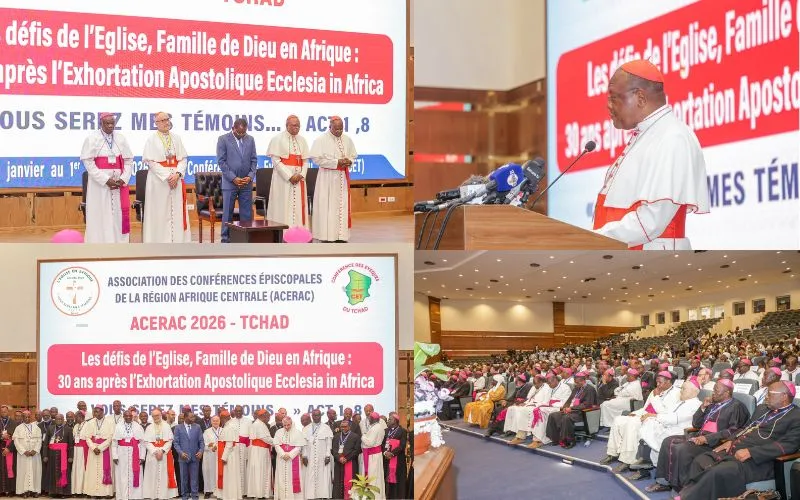
Credit: Catholic Archdiocese of N’Djamena

The vision of the Church as the “Family of God,” articulated 30 years ago in Ecclesia in Africa, remains “relevant” for the Church in Central Africa amid conflict, insecurity, and social fragmentation, the President of the Symposium of Episcopal Conferences of Africa and Madagascar (SECAM) has said.

In his address during the opening ceremony of the 13th Plenary Assembly of the Association of Episcopal Conferences of Central Africa (ACERAC) in N’Djamena, Chad, Fridolin Cardinal Ambongo recalled that at the close of the Special Synod for Africa, Pope St. John Paul II offered the continent “a profound vision” through the apostolic exhortation Ecclesia in Africa.

The SECAM President said that Pope St. John Paul II “called the Church to be fully the Family of God, a communion rooted in love, marked by reconciliation, animated by justice, and committed to peace.” 

In his address during the Monday, January 26 event that was held at the conference hall of Chad’s Ministry of Foreign Affairs, Cardinal Ambongo noted that Pope St. John Paul II’s vision “was not a simple theological ideal, but a true pastoral roadmap for a continent emerging from colonialism, dictatorships, and divisions, while being inhabited by a living faith and great hope.”

Reflecting on the theme of the Assembly, “The challenges of the Church, Family of God in Central Africa: 30 years after Ecclesia in Africa,” Cardinal Ambongo said the anniversary is not merely chronological but a moment of ecclesial self-examination.

Advertisement

“The vision of the Church as the Family of God, proposed by Ecclesia in Africa, remains strikingly relevant thirty years later,” the SECAM President said.

He added, “30 years are not only a chronological marker, but a time of ecclesial examination of conscience. They call us to discern with lucidity what has borne fruit — in particular the vision of the Church as Family of God — and what remains fragile or unfinished.”

He emphasized that the mission entrusted to the Church remains pressing, saying, “They revive above all the urgency of the mission entrusted to us: to be artisans of reconciliation, justice, peace, and hope, in fidelity to the Gospel and in dialogue with the concrete realities of our peoples.”

Addressing the situation in Central Africa, the SECAM President noted that the region continues to face “situations of conflict and insecurity,” where “violence, armed groups, and the fragility of peace processes deeply wound persons and communities.” 

The Local Ordinary of the Catholic Archdiocese of Kinshasa in the Democratic Republic of Congo (DRC) warned that social cohesion is being strained by “ethnic tensions, polarization, and the rise of mistrust,” while corruption and governance challenges undermine human dignity and integral development.

More in Africa

At the same time, Cardinal Ambongo acknowledged that “the life of the Church in Central Africa remains a source of hope.” 

The Congolese member of the Order of Friars Minor Capuchin (OFM Cap) pointed to the “deep faith” of the people, “vibrant liturgical life,” and the generosity of bishops, priests, consecrated persons, and lay faithful who serve “with courage.”

However, he cautioned that the moment also calls for honesty, saying, “The hour is also one of lucidity.” 

Reaffirming the relevance of Ecclesia in Africa, Cardinal Ambongo said the Family of God model offers “a true path of peace” in a region marked by violence and exclusion. 

“The family means belonging, where no one is excluded and where every voice counts,” he said, adding, “It implies listening and solidarity, capable of healing wounded memories.”

Advertisement

The SECAM President identified three pastoral priorities for the Church in Central Africa. 

The first, he said, is “the formation of builders of peace,” calling on seminaries, Catholic universities, and lay formation structures to intentionally prepare men and women “capable of promoting peace, rooted in the Gospel, nourished by the Church’s Social Doctrine, and equipped with skills in dialogue and conflict transformation.”

The second priority, according to the Cardinal, is “synodal pastoral governance,” urging Dioceses and Parishes to strengthen “processes of listening, co-responsibility, and transparency, so that the Church truly walks together as a family.”

The third priority is “prophetic social engagement.” 

“The Church must continue to strengthen its Justice and Peace Commissions, promote civic education, accompany victims of violence, and create spaces for dialogue contributing to reconciliation and social cohesion,” he said.

(Story continues below)

Cardinal Ambongo reaffirmed SECAM’s commitment to accompany ACERAC, saying the regional body can count on the continental organization “through coordination, advocacy, continental solidarity, and the sharing of pastoral experiences and good practices.”

Entrusting the Assembly to the Holy Spirit, he prayed that God would “guide your reflections, enlighten your decisions, and renew your pastoral zeal,” and invoked Mary, “Mother of the Church and Queen of Africa,” asking that the Lord grant “peace, reconciliation, and hope” to the peoples of Central Africa.

The January 25 – February 1 Plenary Assembly brings together Catholic Bishops and Church leaders from Central Africa to reflect on the mission of the Church three decades after Ecclesia in Africa, amid the region’s complex social, political, and pastoral challenges.

Jude Atemanke is a Cameroonian journalist with a passion for Catholic Church communication. He holds a Bachelor’s Degree in Journalism and Mass Communication from the University of Buea in Cameroon. Currently, Jude serves as a journalist for ACI Africa.