


Advertisement

“A historic turning point for Church”: Catholic Bishops on Fruits of Ecclesia in Africa After 30 Years

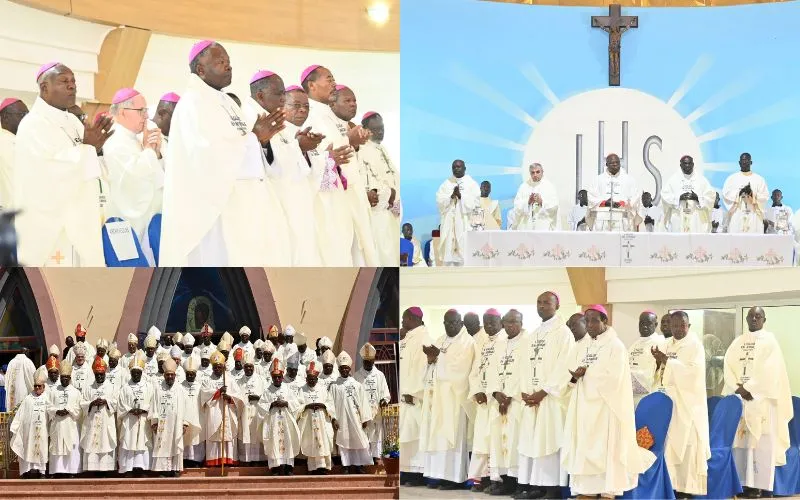
Credit: Archdiocese of N’Djamena

Members of the Association of Episcopal Conferences of Central Africa (ACERAC) have reflected on the fruits of Ecclesia in Africa in the sub-region of Central Africa 30 years after its promulgation, noting that the document has marked “a historic turning point for the Church” on the continent.

In a statement following their January 25 to February 1 Plenary Assembly that was held in N’Djamena, Chad, the Bishops from Cameroon, Central African Republic (CAR), Chad, Equatorial Guinea, Gabon and Congo, said that the document that was promulgated in Cameroon on 14 September 1995 illustrates the image of the church that is awakening.

The Catholic Bishops said that the post-Synodal document promulgated by Pope St. John Paul II following the first special Assembly of the Synod of Bishops for Africa in Rome has shaped the Church in Africa in its evangelising mission.

“This document gave new impetus to its evangelising mission through the various themes it highlighted: the Church as the Family of God, inculturation, agents of evangelization, structures of evangelisation, and self-sufficiency,” ACERAC members said in their 10-page statement.

Reflecting on the fruits of the document, the Bishops said, “The model of the Church as the Family of God proposed by the Synod proved to be deeply suited to the socio-cultural realities of Africa.”

Advertisement

The document, they said, “expresses the desire to build a Church rooted not in imported models, but in living African values. The family, particularly in Africa, is not limited to the nuclear family but encompasses the extended family. It is a fraternal community where everyone has their place and role to play.”

The Bishops said that the dynamic nature of the family in Africa has led to the emergence of Living Ecclesial Communities (LEC) and Basic Ecclesial Communities (BEC) within Christian communities.

They explained, “These are communities based on geography and/or culture, which are places of prayer and listening to the Word of God, of practising the sacraments, of communion and Christian witness.”

“They (communities) act as lifelines in the face of other religious denominations. They remain sources of hope that enable people to openly assume their religious identity: they are no longer afraid to be Christian in front of others,” the Bishops said in their statement following their 13th Plenary Assembly that was organized on the theme, “The challenges of the Church, Family of God in Central Africa: 30 years after Ecclesia in Africa.”

The Bishops said that inculturation, the necessity and urgency of which is emphasized in Ecclesia in Africa, is already showing signs of progress, particularly in liturgical celebrations.

More in Africa

They explained that inculturation in almost all the churches of Central Africa is witnessed in the procession of the Gospel book during the Eucharistic celebration, the celebration of Holy Week, and the integration of the symbolism of the Tree of Peace into the liturgy.

They further said that the Churches in the region also have an inculturated rite of funerals, the insertion of the rhythm of the broom into the liturgy, and the seated position for listening to the Word of God in the liturgical celebration.

The Bishops also attribute the production of specific Catechisms and the translation of biblical and liturgical texts to Ecclesia in Africa.

As a result of the Catechisms, ACERAC members said that the Church-Family of God in Central Africa is experiencing rapid and significant growth, driven by a high baptism rate and strong community involvement.

“The sub-region of Central Africa has become a major centre for the expansion of the faith. It is part of the dynamic of the whole of Africa, which is home to the fastest-growing Catholic population in the world,” they said.

Advertisement

With the increasing Catholic population, ACERAC members underlined the need for theological training for the Laity through the proliferation of catechist training centres in most particular Churches and theological training structures for the Laity.

The Bishops also linked the better use of the means of social communication in the subregion to the post-Synodal Document, adding that the majority of Dioceses have set up communication structures, including newspapers, radio stations, analogue and digital television channels.

“All this is a sign of the blossoming and maturing of a social Christianity supported by the formation of the Laity,” they said, adding that even though the world’s second-largest continent has its own challenges, the spirit of hope remains alive.

ACERAC members said that the document has inspired the spirit of self-reliance among the countries in central Africa.

“There is a growing awareness of the need for our churches to take charge of themselves, through better management of human resources and heritage assets, as well as the implementation of self-financing initiatives,” they said.

(Story continues below)

They added, “It is gratifying to note that some dioceses in the sub-region no longer need to rely on external aid for their day-to-day operations and are sometimes able to come to the aid of other, poorer dioceses, in a spirit of South-South cooperation.”

The Bishops also acknowledged what they described as an extraordinary growth in vocations to the Priesthood and Consecrated Life in the sub-region.

 “Central Africa is now a veritable vocational reserve not only for itself but also for the Churches of old Christianity, with an increasing number of priests, religious men and women in pastoral mission, as well as lay people who are revitalizing the life of many ecclesial communities in the West,” the Bishops said.

Silas Mwale Isenjia is a Kenyan journalist with a great zeal and interest for Catholic Church related communication. He holds a Bachelor’s Degree in Linguistics, Media and Communication from Moi University in Kenya. Silas has vast experience in the Media production industry. He currently works as a Journalist for ACI Africa.