Advertisement

Chad’s Christian Lay Executives Urge Religion-State Separation, Call on President Déby to End Religious Discrimination

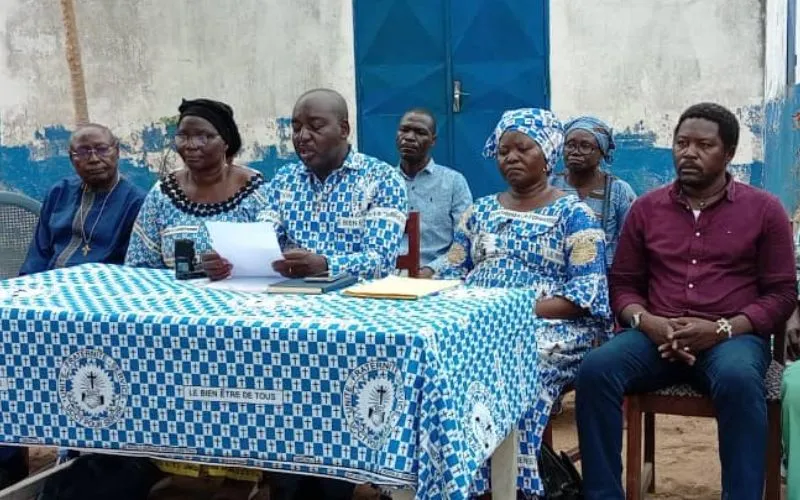
Members of the Union of Christian Executives of Chad (UCCT). Credit: UCCT

Members of the Union of Christian Executives of Chad (UCCT) have urged the country’s President, Mahamat Idriss Déby Itno, to realize the separation of religion from the State, guarantee equal justice, and end what they describe as “religious discriminations” in the landlocked country at the crossroads of North and Central Africa.

In an open letter issued Thursday, September 25 and addressed to President Déby, UCCT members say their appeal was made “not by defiance, but with seriousness, hope, and by moral and patriotic obligation,” stressing that it is rooted in “the breath of the Gospel Beatitudes and the call to justice of the Holy Qur’an.” 

They note that the initiative was not to divide but “to awaken the conscience of the nation” in the face of threats to Chad’s constitutional principles of secularism, equality, and unity.

Highlighting concrete grievances, the Lay executives decry “the growing imprint of a single religious denomination in the institutions of the Republic.” They also mention the construction of mosques in public institutions, government involvement in organizing the Muslim annual pilgrimage known as the Hajj, and official speeches limited to Muslim religious feasts. 

“May our country remain a common space for all, without religious favouritism,” UCCT members say.
Advertisement

They express dismay over persistent attacks against the Catholic Church, recalling “the desecration of places of worship, kidnappings of Priests, threats against Bishops, humiliation of Clergy, and physical assault of Archbishop Goetbé Edmond Djitangar of N’Djaména Archdiocese.” 

All these, UCCT members lament, met with “near total indifference of the authorities.” 

They further lament that “this silence has become deafening,” urging that “justice protect all citizens, without distinction of faith.”

The Catholic Lay Executives further denounce what they called “a multi-speed justice” in managing intercommunal conflicts, with authorities allegedly acting swiftly in cases involving the Muslim-majority north while neglecting deadly clashes in the Christian-majority south. 

They warn that this “manifest gap of treatment” fosters “a deep sense of injustice and contempt, contrary to the republican spirit.”

More in Africa

Equally troubling, UCCT members condemn the “gradual erasure of Christians in public life,” citing their near absence in high-ranking state positions, scholarships, and public contracts, alongside growing obstacles for Christian traders and schools. 

They describe recent discriminatory threats by a member of the defense forces against citizens of the Sara ethnic group as evidence of “a worrying and discriminatory orientation within parts of the State.”

The Catholic executives also express concern about “a policy of progressive appropriation of farmlands in southern Chad,” which they say has forced local families to abandon ancestral lands to newcomers without compensation. 

They denounce the “deportation of children from the South to the North” into forced labor as “a grave violation of fundamental rights.”

Calling for urgent reforms, UCCT members propose an audit of representation in state institutions, the establishment of an independent commission on secularism, a national reconciliation program, the protection of all places of worship, and the recognition of the Catholic Church’s contributions to peace, education, and social cohesion.

Advertisement

“History will remember if you have been the man of reconciliation or the man of silence. We still believe that you can restore the dignity of every Chadian, whatever their religion. May God, the Just, bless and enlighten you in this crucial mission,” UCCT members say in their September 25 open letter.

On September 10,  the Catholic executives expressed their support for the Catholic Bishops’ recent rejection of the draft Pastoral Code by the government, warning that the proposed legislation threatens peace, unity, and the survival of farmers in the country.

Jude Atemanke is a Cameroonian journalist with a passion for Catholic Church communication. He holds a Bachelor’s Degree in Journalism and Mass Communication from the University of Buea in Cameroon. Currently, Jude serves as a journalist for ACI Africa.