 Credit: Catholic Diocese of Tombura-Yambio (CDTY)
Reflecting on “Blessed are those who mourn”, he said missionaries shared deeply in the suffering of the people, mourning sickness, death, war, displacement, and injustice alongside the communities they served.
He said that the early missionaries did not observe suffering from a distance, but carried it in their hearts, stressing that authentic mission is inseparable from solidarity with the suffering.
On “Blessed are the meek”, the Bishop highlighted the respect missionaries showed for culture and human dignity, noting that they did not destroy local identity but purified culture with the Gospel.
 Credit: Catholic Diocese of Tombura-Yambio (CDTY)
(Story continues below)
He said the missionaries trusted local leadership and believed deeply in succession, working deliberately to train, ordain, and consecrate local priests and religious so that the Church would belong to the people.
The Bishop reflected on the Beatitude“Blessed are those who hunger and thirst for righteousness,” describing the missionaries’ approach in Sudan as the wisdom that saved the local Church.
Recalling the expulsion of foreign missionaries in 1964 by the Sudanese Muslim government, he noted that the Church did not collapse because there were already local Priests and religious.
 Credit: Catholic Diocese of Tombura-Yambio (CDTY)
“In our Diocese at that time, there were only five Priests and six Sisters, yet the Church survived,” he said, emphasizing that such history is not merely a memory but “a pastoral lesson” for the present.
Reflecting on “Blessed are the merciful”, Bishop Hiiboro described Consecrated Life as mercy in action, seen in teaching the young, healing the sick, comforting the wounded, and reconciling divided communities.
 Credit: Catholic Diocese of Tombura-Yambio (CDTY)
In the fragile context of South Sudan, he said, Consecrated men and women continue to be visible signs of mercy and hope, adding, “For this faithful service, we say: thank you.”
 Credit: Catholic Diocese of Tombura-Yambio (CDTY)
Reflecting on “Blessed are those persecuted for righteousness’ sake”, he said the Church in South Sudan “was born in sacrifice, survived persecution, and will grow through faithfulness.”
Addressing young people, especially young women, he said, “God is still calling you. Do not be afraid.” To religious communities, he urged them to “plant seeds that will outlive you.”
 Credit: Catholic Diocese of Tombura-Yambio (CDTY)
The Bishop said that The Beatitudes are not ideals reserved for a few, but “the pastoral plan of Jesus” that shaped the missionary journey of the Church and must continue to guide its future.
“May consecrated life continue to be a light, a memory, and a promise for our diocese and for South Sudan,” he implored.
Silas Mwale Isenjia is a Kenyan journalist with a great zeal and interest for Catholic Church related communication. He holds a Bachelor’s Degree in Linguistics, Media and Communication from Moi University in Kenya. Silas has vast experience in the Media production industry. He currently works as a Journalist for ACI Africa.


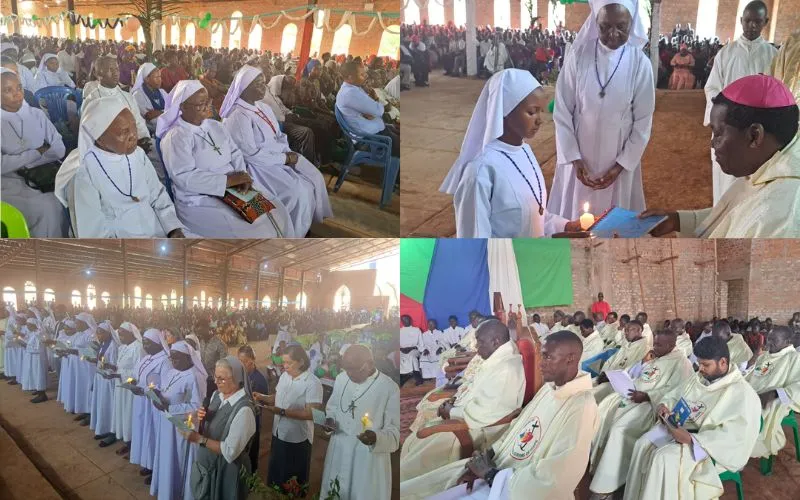

 Credit: Catholic Diocese of Tombura-Yambio (CDTY)
 Credit: Catholic Diocese of Tombura-Yambio (CDTY)
 Credit: Catholic Diocese of Tombura-Yambio (CDTY)