Advertisement

Africa’s Youth Reflect Profound Social Transformation, Not Just “demographic indicator”: SECAM President

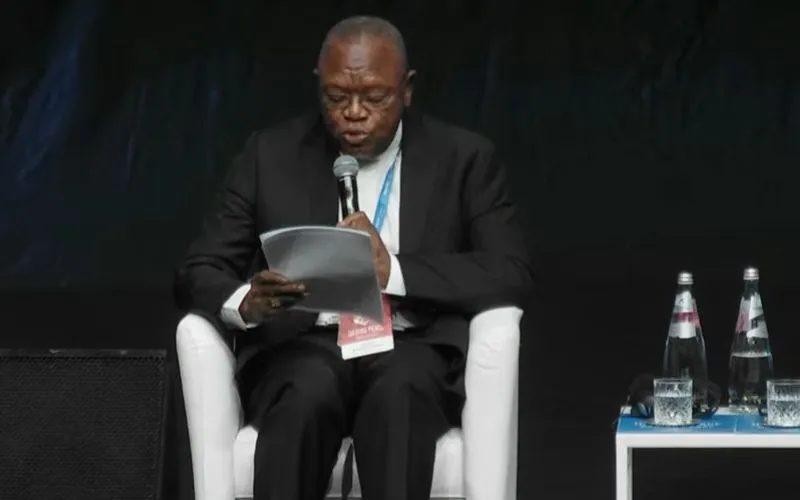
Fridolin Cardinal Ambongo. Credit: Community of Sant'Egidio

Young people in Africa reflect a “profound” social transformation, and their growing numbers are aa tremendous opportunity if they are accorded appropriate education and are empowered, the President of the Symposium of Episcopal Conferences of Africa and Madagascar (SECAM) has said. 

In his presentation on Tuesday, October 28, at the International Meeting of Dialogue and Prayer for Peace in Rome, Italy, Fridolin Cardinal Ambongo emphasized that Africa, being the youngest continent with more than 60 percent of its population under the age of 25, should not be perceived as a mere “demographic indicator” but rather a revelation of “a profound transformation in African societies.”

“Is this boom a threat? Our position is that everything will depend on how Africa listens to, educates, and supports its youth so that they can become the beating heart of its rebuilding and rebirth,” Cardinal Ambongo said during the October 28 forum on “Africa: An Emerging Continent.”

The Local Ordinary of the Catholic Archdiocese of Kinshasa in the Democratic Republic of the Congo (DRC) expressed concern that despite embodying “the vitality, creativity, and resilience of the continent,” Africa’s youths continue bearing “the burden of unemployment, poverty, inequality, and violence.”

“The majority of youth in Africa live in extreme precariousness, massive unemployment, limited access to education and healthcare, and a lack of prospects,” he said. 
Advertisement

The Congolese member of the Order of Friars Minor Capuchin (OFM Cap) added, “In the DRC, in fact, the poverty rate among young people exceeds 85%, and many struggle to access technical or vocational training in particular.” 

“The diplomas and certificates awarded by our universities are often described as ‘diplomas for unemployment,’ yet, despite these obstacles, a new generation is emerging—Generation Z (Gen Z),” he said, recalling the recent incident in Madagascar, where “these young people managed to overturn the government and remove the president.”

He told the forum at the October 26-28 international event Sant’Edigio organized under the theme, ‘Daring Peace,’ that the Gen Z in Africa “is connected, inventive, and daring. We see that these young people, active on social media, are demanding justice, dignity, and participation in the management of public affairs.”

The Indian Ocean nation of Madagascar is to be under military rule from October 17 following weeks of political unrest and nationwide protests that led to the ouster of President Andry Rajoelina, on October 14, the same day lawmakers impeached President Rajoelina, who had fled the country amid the unrest two days earlier.

On October 6, Archbishop Benjamin Marc Balthason Ramaroson of the Catholic Archdiocese of Antsiranana in Madagascar told ACI Africa in an interview that the protests were an expression of legitimate frustration among young people demanding that their basic rights be respected.

More in Africa

“The youth, unarmed, wanted to claim their fundamental rights, but the repression was very harsh, and we must acknowledge that. There were deaths, including three in the Archdiocese of Antsiranana,” Archbishop Ramaroson lamented.

Meanwhile, in his October 28 presentation, Cardinal Ambongo noted that frustration among young people is not only driving them to demand their basic rights but also pushing some into illegal immigration.

“When their dreams are stifled, many turn to exile and migration. They cross the Sahara or the Mediterranean under tragic conditions,” he said, and added, “These deserts and seas have become graveyards for these young Africans.”

He continued, “These mass migrations are not only due to economic reasons; they reveal a deep moral and political crisis. They call into question the responsibility of leaders who no longer have a vision for a common future.”

Cardinal Ambongo also attributed the mass migration of the youth to “wars and armed conflicts, which in Africa are the flip side of poor governance and a lack of political will.”

Advertisement

“Beyond the endogenous causes of these wars, there is above all the plundering of Africa’s soil, minerals, and subsoil resources. Those who unjustly exploit these resources either support corrupt leaders or fuel tensions,” he stated.

For him, enhancing the transformative strength represented by the youth in Africa and averting a social crisis that could be difficult to manage requires an answer that is not “purely economic; it must also be ethical, spiritual, and communal.”

“The Church, civil society, and public institutions must work together to offer these young people the conditions for a dignified and fruitful future,” he said and went on to emphasize that “young people in Africa are not just waiting for jobs; they are calling for meaning, recognition, and a mission to fulfill.”

He added, “The Church must become the place where dreams become possible. It must support a true entrepreneurship of dreams, train young people in responsibility, protect them from illusions, and prepare them to serve the common good.”

“This calls for significant human and spiritual investment in the education, training, and vocational guidance of young people,” said the Congolese Catholic Church leader, who began his Episcopal Ministry in the Catholic Diocese of Bokungu-Ikela in March 2005.

(Story continues below)

Cardinal Ambongo observed that Africa, through its youthful population, “is at a historic turning point. It can become a workshop of peace, innovation, and faith if it seals a new educational and spiritual pact inspired by Pope Francis’ global compact.

“This pact places the human person at the center of all education and promotes a continental alliance to form responsible, spiritually rooted, and socially committed citizens,” he said on October 28, alluding to the late Pope Francis’ October 2020 message, “Global Compact on Education: Together to Look Beyond."

Nicholas Waigwa is a Kenyan multimedia journalist and broadcast technician with a professional background in creating engaging news stories and broadcasting content across multiple media platforms. He is passionate about the media apostolate and Catholic Church communication.