Advertisement

Inequality, Resource Exploitation Drive Instability and Coups in Africa: Cardinal Ambongo

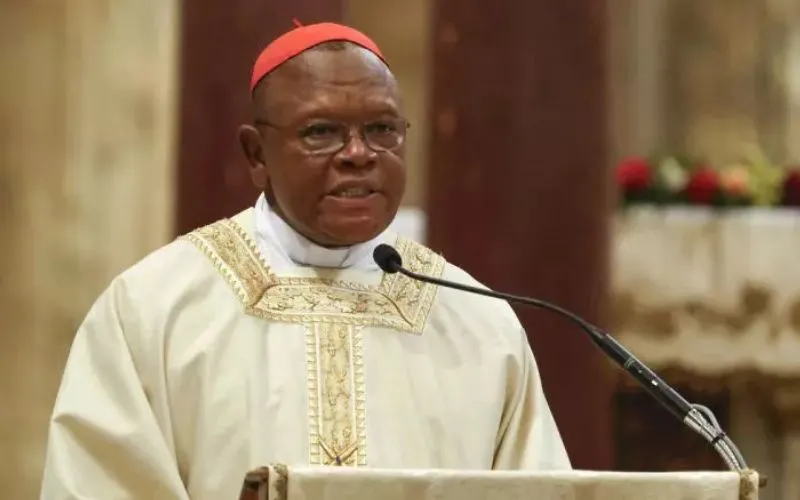
Fridolin Cardinal Ambongo of the Catholic Archdiocese of Kinshasa in the Democratic Republic of Congo (DRC). Credit: Radio Moto

Fridolin Cardinal Ambongo of the Catholic Archdiocese of Kinshasa in the Democratic Republic of Congo (DRC) has warned that growing inequality, poor governance, and the mismanagement of natural resources are at the heart of political instability and repeated coups d’état across Africa.

In an interview with Vatican News following the consistory in Rome, Cardinal Ambongo said that while democracy functions in a few African countries, “globally, in Africa, democracy is lagging behind, living together is lagging behind.” 

He added that this trend is not limited to Africa alone, noting that “it seems that it is a global current which is now blowing over the whole world.”

Reflecting on the coups and attempted coups that marked 2025, the Archbishop of Kinshasa said they clearly reveal failures in governance.

“All these coups d’état clearly show that the exercise of power has gone wrong in Africa,” he said. 

Advertisement

According to him, those behind coups are often “people who feel frustrated, who feel that the cake is shared between a small elite, a small group, and the majority has no access.”

“To avoid the coup d’état,” Cardinal Ambongo argued, “we must return to a system of equitable redistribution of the wealth of our continent,” and to “the exercise of a power that watches over the rights of one and the other in a fair and just way.”

According to the Congolese Cardinal, political life in many countries has become dominated by the quest for power and wealth. 

“We have the impression that more and more in our African countries… only the will of power matters today,” he said.

The Local Ordinary of Kinshasa Archdiocese, who also serves as President of the Symposium of Episcopal Conferences of Africa and Madagascar (SECAM) added,  “The powerful impose their will on the smallest. The only thing that matters is wealth.”

More in Africa

Cardinal Ambongo lamented that the pursuit of wealth often comes at the expense of the majority of the population. 

“We are ready to go and get this wealth by resorting to any method,” he said, adding that once obtained, it is used “first for ourselves, for the people of our family, for the people of our group, and the majority of the population is abandoned.”

This situation, he explained, has created “a kind of imbalance, of inequality between those who have, and those who have in Africa are generally those who are in power.” 

Those without power, the Cardinal said, are “thrown into misery, into poverty,” a reality he described as “at the origin of many conflicts today in Africa.”

The Congolese member of the Order of Friars Minor Capuchin (OFM Cap) also addressed the issue of natural resources, noting that Africa is often seen by external powers as a source of raw materials. 

Advertisement

He recalled Pope Francis’ denunciation in Kinshasa, saying that Africa is viewed “as a well where we can go and look for what they call today strategic minerals, for their industry, to allow them to dominate the world.”

While insisting that resource extraction itself is not the problem, Cardinal Ambongo faulted the methods used. 

“We sometimes use certain Africans to access the minerals, our resources, but only for their own interest, not for the interest of the global population,” he said, warning that “as long as the system continues to function like this, we will always have war.”

Despite Africa’s many challenges, the Cardinal offered a message of hope and encouragement. 

He urged Africans “to never despair, not to throw the sponge,” and to continue believing in their ability to shape their future. 

(Story continues below)

“We must reassure ourselves that we can change the course of history,” he said, adding, “The future of this continent depends on you, depends on us.”

Jude Atemanke is a Cameroonian journalist with a passion for Catholic Church communication. He holds a Bachelor’s Degree in Journalism and Mass Communication from the University of Buea in Cameroon. Currently, Jude serves as a journalist for ACI Africa.