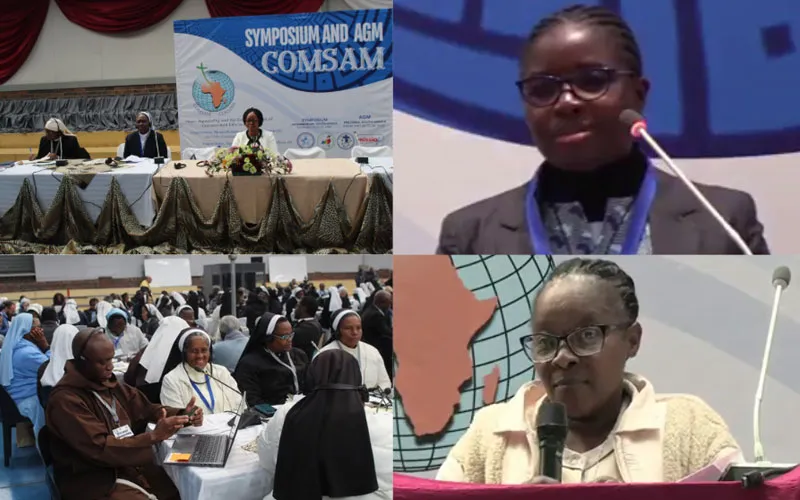
“We need to create safe spaces where victims can express themselves and feel at home,” Sr. Siabana said, underscoring the need for transparency in ICLSAL, where the welfare of victims of abuses is prioritized over institutional reputation.
She emphasized, “If we are to journey together as pilgrims of hope, let us be bearers of hope for one another; let us be our brother’s and our sister’s keeper.”
Also speaking during the May 24 sessions, Sr. Jane Joan Kimathi reflected on how the African tradition of palaver—communal dialogue rooted in mutual respect—has significantly shaped the participation of women and men Religious in Africa in the multi-year Synod on Synodality.
In her presentation titled, “The contribution of African Palaver to African Participation in the Synod”, Sr. Jane said that the Pan-African Catholic Theology and Pastoral Network (PACTPAN) convened 14 thematic palaver sessions aligned with the synodal journey.
The sessions, the PACTPAN Director of Programs said, brought together contributions from Cardinals, Catholic Bishops, theologians, pastoral workers, and ICLSAL across the continent and the diaspora.
(Story continues below)
These gatherings were spaces of honest sharing, deep listening, and collaborative discernment that enriched the Church’s synodal process from an authentically African perspective, Sr. Jane said.
Describing the African palaver as “a communal dialogue,” she noted that the tradition echoed the Ubuntu philosophy, which is, “I am because we are.” Through such dialogue, “we sat together without pointing a finger… we listened. And we reached a consensus together,” the Kenyan member of the Congregation of Sisters For Christian Community (SFCC) said.
“Many religious communities today face a pressing pastoral dilemma: how to live out evangelical poverty while maintaining the economic sustainability of the ministry?” She posed and further queried, “How do I live my poverty within the poverty that I'm serving?”
Sr. Jane called for ethical stewardship, financial innovation, and leadership formation rooted in African realities. She said, “Empowerment then is not about exercising control or dominance; rather, it's about nurturing the inner capacity of the individual. How can I get my sisters up within the society of South Africa? That’s part of economizing our economy within ourselves.”
Beyond economics, she advocated for a formation that integrates spiritual rootedness with social awareness. “We are not just to form people spiritually, but also to equip them to respond to the reality of the time,” Sr. Jane said.
She noted that Consecrated Life in Africa holds immense promise. “Grounded in the theological virtue of hope, by participatory spirit of synodality and strengthening our empowerment — personal, economic empowerment — consecrated persons are well-positioned to lead the Church into a renewed future in Africa,” she said.
Sr. Jane appealed, “Let us work together as one body, inspired by Christ’s call to abundant life for all God’s people in Africa.”
Jude Atemanke is a Cameroonian journalist with a passion for Catholic Church communication. He holds a Bachelor’s Degree in Journalism and Mass Communication from the University of Buea in Cameroon. Currently, Jude serves as a journalist for ACI Africa.