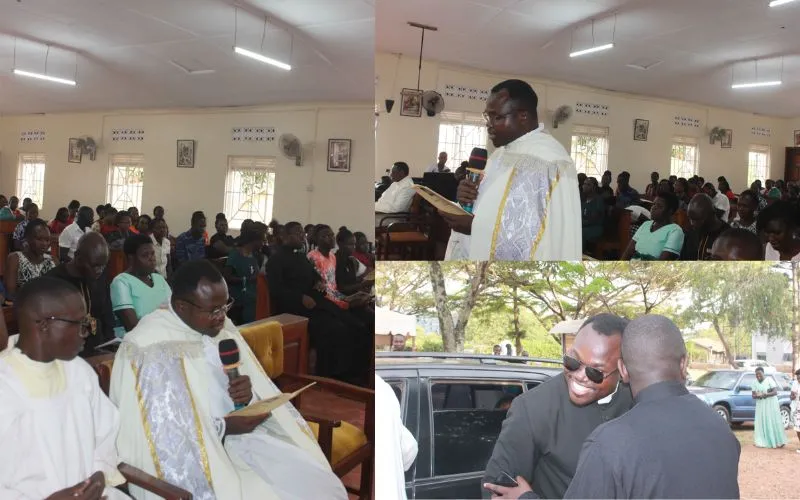
On how he has been adjusting at his new workstation, Fr. Stephen says, “It is not the same here as it was at St. Ephraim Parish. The dynamics are different. Naggulu Parish is also a national shrine for the Saint Jude Devotion so it's quite busy.”
“Here, we have three Holy Masses every day. We conduct visitations to different institutions. We also have six Holy Masses on Sundays,” he said, and added, “I had to immediately immerse myself in the work at hand. I reported as one of the three Priests helping the Parish Priest.”
“I am loving it here. It may be a lot busier that what we had at St. Ephraim but it is being busy in a good way,” he said.
The Ugandan Catholic Priest however admitted that it had taken him a while to get used to being away from parishioners at St. Ephraim.
“At first, it was a bit painful having left those people that I had grown to love and to care about so much. Having to cut the ties and concentrate on my new station is not something that was easy. Luckily, they received another shepherd and him and I worked together to ensure that he is well settled in,” he shared.
(Story continues below)
His visa dilemmas did not leave him without valuable lessons, he said, and added, “I learned the importance of having another plan to fall back to should things not go as we planned.”
“I learnt the importance of having someone who understands legal requirements in immigration. I also realized is that while the Church is responsible for Priests, for instance in making sure that the Priests have the right status in the country, and their visas are updated, it is an individual Priest who bears the consequences of the breakdown in communication,” Fr. Stephen said.
“One should always be aware that it doesn't matter who sent you to the country, or who invited you to the country. When it comes to the immigration, you bear the consequences as an individual,” he said, and added, in his advice to colleagues, “I advise fellow Priests to organize themselves in such a way that they do not give law a chance to work against them.”
The Ugandan Priest told ACI Africa that he felt in necessary to share an update of his situation, so as to inspire courage and hope in those who may have undergone a challenge similar to his.
He said that he also felt it necessary to debunk misconceptions about visas granted to missionaries.
“Some people who read my story could not understand why Priests are granted work permits yet they don’t have jobs in their host countries,” he said, and added, “Some believe that work permits are only granted to people with ‘a skill’ in the traditional sense. They believe that a Priest’s work is not a skill.”
“Being a Priest is not a job. It's a vocation,” he clarified.
He said that he had received calls following the ACI Africa publication from people who, out of concern, felt that the Priest had been left to do things on his own without the help of his Diocese in South Africa.
“This is not true,” Fr. Syambi said, and added, “The Diocese is the one that invites me, the Diocese is the one that submits all the necessary papers. I must clarify that immigration offices deals with an individual, not an institution. The Church did its part. The Episcopal conference also did its part. Even now that I left, they are still in touch with me, making sure that I am okay wherever I am, and they are supporting me.”
“My Bishop has been hands-on and he's helping me to settle in, even here at home,” he said, and added, “I would like to let everyone that was touched by my story know that I am not just thrown out there to fend for myself. I am still within the Church, and I am still supported by the Church.’
In his message of gratitude to the people who journeyed with him through his dilemma, Fr. Stephen said, “I just want to say thank you. Thank you, my Bishop Victor and the Diocese of Klerksdorp. I also want to thank the Archbishop of Kampala for welcoming me and assigning me to the Parish where I work, and where I now work and where I was received so well.”
Fr. Stephen also thanked ACI Africa for amplifying his voice, saying, “Thank you for making this story known, and for supporting us in our struggles and making sure that our stories don’t go untold.”
“I pray that through this story others experiencing a challenge such as mine find some consolation,” he said, and added, “Through this story, we hope that immigration officers in South Africa, or the minister himself will resolve some of the challenges we are facing in the country. This will be good for the Church because Priests are needed in South Africa.”
Agnes Aineah is a Kenyan journalist with a background in digital and newspaper reporting. She holds a Master of Arts in Digital Journalism from the Aga Khan University, Graduate School of Media and Communications and a Bachelor's Degree in Linguistics, Media and Communications from Kenya's Moi University. Agnes currently serves as a journalist for ACI Africa.